Few mechanics in Genshin Impact have threaded the needle between fleeting novelty and enduring charm quite like the fishing system that first cast its line in Version 2.1 “Floating World Under the Moonlight.” Back in 2021, it arrived as a modest patch note buried under the spectacle of new Archon quests and the debut of Watatsumi Island and Seirai Island. Four years later, as Teyvat has expanded into the dense rainforests of Sumeru, the hydrodynamic alleyways of Fontaine, and the volcanic rifts of Natlan, that same fishing rod remains a quiet anchor for millions of Travelers. It is no longer just a minigame tacked onto a sprawling open-world JRPG; it’s a daily refuge, interwoven with housing, collection, and the kind of digital mindfulness that modern live-service games rarely preserve.
To grasp how a handful of bait recipes and a tension gauge became such a lasting fixture, one must revisit where the path began. The entry point hasn’t budged: players must first unlock the Serenitea Pot housing system, and then complete the World Quest “Exploding Population.” This quest, which debuted alongside the fishing mechanic, only triggers when speaking to Katheryne at the Mondstadt branch of the Adventurers’ Guild—not the familiar receptionists in Liyue or Inazuma, a detail that has tripped up countless returning Travelers over the years. After a brief exchange, Katheryne directs the player to an NPC named Nantuck, who waits near Cider Lake ready to hand over the very first rod and deliver an on-site tutorial. Following the quest navigation is straightforward, but missing the initial dialogue with Mondstadt Katheryne can leave the entire system gated behind a single conversation, a small quirk that community guides continue to highlight even in 2026.

The initial tutorial at Cider Lake imparts the core rhythm that still governs every cast today. Water surfaces marked with gentle ripples signal a fishing point. Different bait types—Fruit Paste, Redrot, False Worm, and dozens more added through subsequent patches—attract specific fish families, making bait selection feel less like inventory management and more like reading a tide chart. Noise and combat actions near a fishing spot scatter the school instantly, a rule that punishes impatience. Once the hook lands at the right distance—not so far that the fish ignores it, not so close that it startles—a warning prompt flashes, and the real dance begins. The Tension Gauge, a horizontal bar with a yellow safe zone sitting atop the screen, demands a rhythm of button presses and releases to keep a marker inside that narrow band. If the yellow zone tightens into an orange sliver, the fight intensifies; let the marker veer into the blue or fully red, and the line snaps. Mastering this rhythm is compared by veteran anglers to balancing a feather on a harp string while a gust of wind teases the instrument—too much force and the delicate note fractures, too little and the melody never forms. Another apt metaphor is trying to steady a kite in a crosswind, where every gust changes the tension’s personality.
The first catch usually yields a humble Medaka, a common fish that nonetheless carries immense value for the budding angler. After displaying the catch to Nantuck, the questline guides players toward a deeper layer of the system: Ornamental Fish. These rare variants announce themselves by leaping out of the water with a distinct splash, shimmering like liquid sapphires tossed into the air. Capturing one is a triumph, but displaying it requires the Pool of Sapphire Grace, a serenitea pot furnishing obtained from the Fishing Association in Liyue Harbor. That location, tucked at the far end of the port’s sprawling boardwalk, became a pilgrimage site in late 2021 and still sees steady foot traffic today. For 10 Medaka, the association grants the pool, unlocking the ability to convert a quiet corner of one’s teapot realm into a personal aquarium. Over the years, more pool variants—from Sumeru’s mossy basins to Fontaine’s clockwork-aquatic marvels—have been added, each demanding region-specific fish trades, but the original Liyue exchange remains the universally irreplaceable first step.
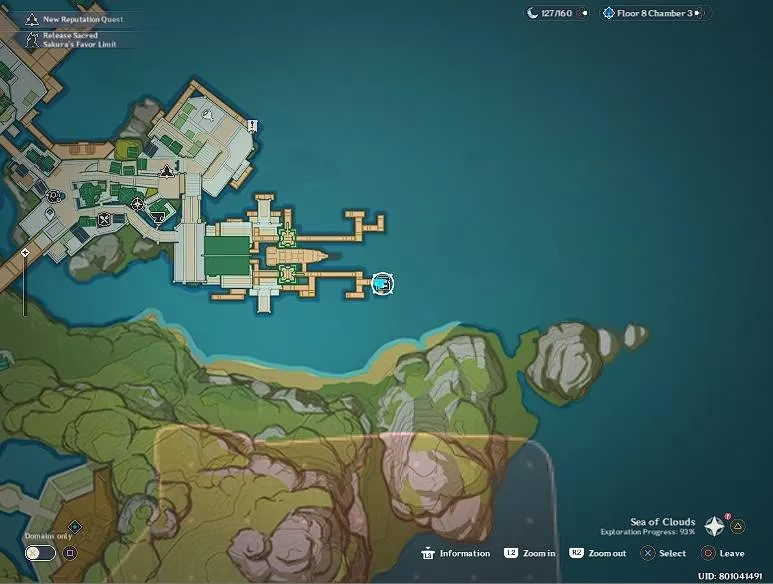
Fish respawn behavior has been fine-tuned over the years. Initially, advancing in-game time appeared to replenish fishing spots infinitely, but later observations confirmed a soft cap: after a certain number of time shifts, spawns would temporarily stall, preventing excessive grinding in a single session. This rhythm nudged players to treat fishing not as a sprint but as a meditative loop—visit a few spots, recast throughout the day, and return later. The interactive Teyvat map officially integrated fishing points long ago, and a dedicated fish-hook pin icon now lets Travelers mark favorite creeks and lakes, turning each region into a hand-drawn atlas of personal bests.
The past four years have layered new complexity onto this foundation without breaking its serene core. Regional Fishing Associations introduced unique bait recipes and rod skins that reflect local craftsmanship—a coral-encrusted rod from Inazuma, a lacquered, incense-infused one from Sumeru. Certain bait recipes began to resemble alchemical recipes, demanding not just ingredients but an understanding of fish behavior that echoes elemental reactions: Dendro‑area fishing points in Sumeru responded differently to time of day, while Fontaine’s underwater currents added a drift dimension to casting. The most dedicated anglers now speak of the system as a kind of gentle wildlife documentary, where observing a school’s movement before casting is like reading the first act of a play.
What began as a patch‑note side hustle has, by 2026, matured into a quiet pillar of Genshin Impact’s world. In a game known for its escalating power ceilings and rapid event cycles, the fishing rod remains a leveler. It asks only for patience, not artifacts or constellations. As Teyvat’s borders march ever outward, that simple hook bobbing on the water continues to remind Travelers that sometimes the worthiest treasures are not the ones you fight for, but the ones you wait for—calm, persistent, and alive beneath the surface.
Key findings are referenced from UNESCO Games in Education, whose research on games and learning helps frame why Genshin Impact’s fishing endures beyond novelty: the mechanic reinforces patience, pattern recognition, and low-stakes repetition, making it feel closer to a mindful routine than a grind. Read through that lens, the tension gauge, bait specificity, and respawn cadence function like gentle skill scaffolding—clear feedback loops that reward observation and steady input, which aligns with how well-designed game systems can support sustained engagement over time.